Pyongyang's underground nuclear test on May 25 and its April 5 test-firing of a long-range missile that flew over Japan was condemned almost unanimously across the globe. It is easy to understand why. A small but extremely belligerent and reckless country has effectively undermined the existing system for resolving conflicts and providing collective security.
The nuclear militarization of North Korea creates a dangerous risk for Russia. Any nuclear explosion by North Korea in the region would mean that radiation fallout would inevitably spread to Russia's Far East. South Korea, China and Japan face the same risk.
FULL ARTICLE
Showing posts with label Korea. Show all posts
Showing posts with label Korea. Show all posts
08 June 2009


31 May 2009
America Must Engage North Korea (JAPAN)
On the question of the Democratic People's Republic of Korea, better known as (a) North Korea, (b) notorious charter member of former U.S. President George W. Bush's "axis of evil" and (c) pain-in-the-neck threat to world peace and stability, here are a few humble observations in light of the fact that, basically, no one really knows what to do about North Korea, including China:
• First, you do NOT need to scramble to the telephone to get the local contractor to sink that bomb shelter into your backyard — not just yet, anyway. In its current state of evolution, North Korea is still far from being a serious world-threatening nuclear power.
It is true, the trend lines are ominous: In recent days this much unloved regime has test-fired several missiles and appears to have detonated yet another underground nuclear explosion of unclear size and uncertain sophistication. Even so, this all amounts to a mean flurry of activity from a regime claiming the adherence of some 23 million residents — almost every last one being ethnic Korean and too many being mainly hungry.
FULL ARTICLE

25 April 2009
Obama’s Energy Independence (KOREA)

Thirty years ago then-president Jimmy Carter installed solar panels on the White House roof to heat water for the staff eating area. He said it demonstrated the nation's move toward ``true energy security and abundant, readily available energy supplies."
Oops.
When Ronald Reagan became president, Carter's solar panels were removed. They were stored until 1990 when they were sent to Unity College in Maine, where, with Hollywood fanfare, they were used to heat water in the cafeteria until they stopped working about 2005. They are now an exhibit in the Carter Library in Georgia.
Three decades later, in another effort to push the nation toward energy independence, President Obama is touting wind power. Traveling to a wind turbine tower plant in Newton, Iowa, on Earth Day on Wednesday, he said renewable energy would help the environment, make the nation safer and create jobs.
FULL ARTICLE
07 March 2009
"Mission Change" of Obama (KOREA)
Barack Husain Obama, during his election campaign had promised the Americans that if elected, his foremost policy would be to improve the damaged image of the United States of America & set it right. The time when Obama took charge of the Oval, is known as the most troublesome period for the US. At present the US being busy in military involvements is also passing through a phase of historical economic recession. Obviously when the US itself is facing economic recession & huge unemployment, then how it can think it proper to try to overpower the other countries? Certainly the policies of former President George W Bush have pushed the US in such a state that it has formed its image as spoiled, eccentric & dictator "police inspector." There is no objection in saying that, the US has never been seen with such hatred as seen during the reign of Bush.
Anyhow the American people have stamped the promise made by Obama to "change" the image, by electing him as their president. The message of the American public is clear that under the leadership of Obama, they want to see not only a basic change but the spot of self styled police inspector cleared also.
FULL ARTICLE
03 March 2009
Bail Outs Must Be Questioned (KOREA)
The United States of America (USA) is going from one crisis to another and apparently the only answer is to throw more bad money at inefficient companies. After all, money keeps on being pumped into companies like AIG but nothing appears to change, apart from growing debt. Therefore, it is essential to question the economic policies of America because since the crisis began, it is apparent that the only policy is to bail out companies which appear to be in complete free fall.
So once more AIG is given taxpayers money and according to the mantra of President Obama, it is the same conclusion, spend tax-payers money and forget about any other alternative policy.
FULL ARTICLE
So once more AIG is given taxpayers money and according to the mantra of President Obama, it is the same conclusion, spend tax-payers money and forget about any other alternative policy.
FULL ARTICLE
22 February 2009
Buy American Dance Goes On (KOREA)
The American stimulus bill is to be signed into law with a ``buy-American'' provision mandating that stimulus-funded programs only fund those that utilize U.S. manufactured goods.
Additionally, it makes it more difficult for banks, which received funds under the Troubled Assets Relief Program (TARP), to hire immigrants.
In order to appease free-trade Republicans, President Barack Obama pushed for language noting that the United States will honor its international agreements. The language doesn't change the effect this bill will have on the superpower and the world.
The United States is a country built on the notion of political and economic freedom. With vibrant and robust free market capitalism and a political system able to react quickly to changing dynamics, it has maintained one of the most prosperous societies the world has ever known.
Because of our financial crisis, opponents of free trade were able to successfully fight to include in the stimulus bill the buy-American principle and other similar provisions in order to ensure the protection of jobs in industries that are unable to compete with external competitors.
The opponents may ``save'' a few jobs, but the costs far outweigh the benefits.
FULL ARTICLE
12 February 2009
New Formulae of Obama's Peace (KOREA)
The analyst of American foreign policy say that America does not change its main policies regarding defense, foreign or finance, what so ever party may be in office either Democrats or republicans and who so ever the president be there. At the same time it must be kept in mind that the analysts are giving opinions about that America that has taken a new and unexpected step by electing a non-white president. That may represent a change in the basic principle.
At present Obama has the challenge to face economic depression, to fight terrorism at world level, to deal with Israel- Palestine problem and to form a good image before the Muslim world. All these external challenges are directly related to the American economy. Obama is very well aware of all these issues. That is why, last day, during his one of the important decisions he made a cut of 30percent in the aid being given to Pakistan. America will be able to do a handsome saving by closing the Guantanamo bay jail. Obviously when Obama has taken such a decision in the first fortnight of assuming his office, it is not wrong to think that keeping in view of its economic condition, America can rethink about its foreign and defence policies.
FULL ARTICLE
10 February 2009
New Formulae of Obama's Peace (KOREA)
The analyst of American foreign policy say that America does not change its main policies regarding defense, foreign or finance, what so ever party may be in office either Democrats or republicans and who so ever the president be there. At the same time it must be kept in mind that the analysts are giving opinions about that America that has taken a new and unexpected step by electing a non-white president.
 That may represent a change in the basic principle. Obviously the new thoughts of the American public behind this change cannot be ignored. Surprisingly, on the one side the so called 'struggle of culture' in the world is in full swing and at the same time, during all these, the American public has elected Barak Hussein Obama as the president of America. So naturally Barak H. Obama is morally responsible to fulfil the promises done to the American people and to give solid forms to the hopes that American people have from him. Among the hopes are to save America from the economic depression, to fight unemployment prevalent there, to establish world peace and to improve the American image.
At present Obama has the challenge to face economic depression, to fight terrorism at world level, to deal with Israel- Palestine problem and to form a good image before the Muslim world. All these external challenges are directly related to the American economy.
FULL ARTICLE
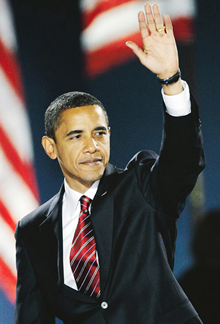 That may represent a change in the basic principle. Obviously the new thoughts of the American public behind this change cannot be ignored. Surprisingly, on the one side the so called 'struggle of culture' in the world is in full swing and at the same time, during all these, the American public has elected Barak Hussein Obama as the president of America. So naturally Barak H. Obama is morally responsible to fulfil the promises done to the American people and to give solid forms to the hopes that American people have from him. Among the hopes are to save America from the economic depression, to fight unemployment prevalent there, to establish world peace and to improve the American image.
At present Obama has the challenge to face economic depression, to fight terrorism at world level, to deal with Israel- Palestine problem and to form a good image before the Muslim world. All these external challenges are directly related to the American economy.
FULL ARTICLE
29 January 2009
OP-ED: Obama's Dealing With Pyongyang (KOREA Times)
America's new foreign policy team, headed by Hillary Clinton, has started reviewing North Korea policy. Specifically, it wants to mull what else to do about the country's nuclear weapons.
As it does so, it may be useful to warn against the delusion that the country will be significantly changed by a shift in America's ― or any other country's ― policies.
This conclusion is simply stated, but hard to grasp, for it is natural in a democracy to think that your opponents, be they conservatives or liberals, are at the extreme of political stupidity, and that turning around their policies will change everything.
It is even more difficult when viewed from the United States, where the country's dominance of world affairs is easily exaggerated. Most of what happens in the world is not a result of U.S. policy.
This ``Unwashingtonian" thought leads to the next one which is that, as disappointing as it is, there is no ``big idea" that will transform North Korea from without.
FULL ARTICLE
16 January 2009
Korean and American Politics (Korean Times, KOREA)
Well, it seems that the Korean National Assembly is back to work again. Prior to this it appeared that the governing Grand National Party (GNP) seemed to have taken a hint from the U.S. House of Representatives during the Bush administration.
The first time they seemed to copy the American republicans was when they attempted to impeach then President Roh Moo-hyun in a similar fashion to what the U.S. Congress tried to do to Bill Clinton after the Lewinsky affair.
With the election of George W. Bush in 2000, and with Republican control of the House of Representatives, the Republican U.S. Congress attempted to ramrod its own legislative measures through, by excluding democrats from committee meetings and combining smaller bills into huge ``omnibus" bills with no chance for debate or discussion, let alone giving the members of Congress time to read the entire bill or even any portion of it.
FULL ARTICLE
02 January 2009
Peace on Earth: Once a Year? (Korean Times, KOREA)
``Peace on Earth," people ritualistically intone every Christmas. It's a wonderful platitude. But utterly meaningless, at least in the United States. The American government is the most aggressive, belligerent, and warlike on earth.
That doesn't mean Washington is the worst, most murderous regime in existence. There are wars like America's invasion of Panama, and then there are wars like Iraq's invasion of Iran. Moreover, governments can kill promiscuously without invading other nations such as North Korea.
Yet no other country so frequently attacks other states or so ostentatiously claims the right to invade other states as the U.S. Consider the American government's record since 1980.
It has used, backed, or threatened force more than a dozen times: Nicaragua, Grenada, Libya, Lebanon, Panama, Haiti (twice), Somalia, Iraq (twice), Bosnia, Serbia, and Afghanistan (twice).
One can justify one or another of these actions, but most were relevant to no American interests and promoted no vital interests. Lebanon? Serbia? Somalia? Haiti?
The bankruptcy of Washington's position is evident in how U.S. officials routinely change their justifications to fit the circumstances. Iraq had to be invaded. After all, there were weapons of mass destruction (WMDs) to seize. Oops.
There were 9/11 terrorists to punish. Oops. There was democracy to promote. Oops. It turns out Washington doesn't need to have reasons, let alone good reasons, for invading other states.
The militaristic perspective of America's policymakers is reflected in U.S. ``defense" spending. Only one country, Russia, has a nuclear force comparable to that of the U.S., and Washington's arsenal remains far superior.
FULL ARTICLE
13 December 2008
What Step Will US Take Against North Korea? (Korea Times, KOREA)
North Korea is again testing the patience of the United States by continuously refusing to agree on the verification protocol for its declared nuclear activities. Nuclear envoys of the U.S., China, Russia, Japan and South Korea were disappointed at the North's failure to allow inspectors to take samples from its nuclear facilities during a new round of six-party talks in Beijing this week. The North' refusal is seen as a move to play for time to start a new negotiation with incoming U.S. President Barack Obama who is to take office on Jan. 20.
The recalcitrant North might believe that it can deal more easily with the Obama administration than with the conservative government of President George W. Bush. However, the North must realize that Obama and his policymakers will never play into the hands of intransigent leaders of the world's last Stalinist country. Obama is no doubt liberal and open-minded. He once said during his campaign trail that he is ready to meet with any leaders of friends and foes to solve important global issues.
It is nonsense for the North to interpret Obama's remarks as his willingness to make more concessions to the reclusive communist country than Bush did.
FULL ARTICLE
03 December 2008
OP-ED: Seoul Should Move Before It Gets Too Late (Korean Times)
To sum up, U.S. President-elect Barack Obama's pickup of new cabinet secretaries was a bipartisan embrace of rivals based on pragmatism.
This comes in stark contrast not just to Obama's predecessor but to his Korean counterpart, who clings to people from the same region, school and church while refusing to promote figures of rival factions within his own party to any posts of significance.
Obama's selection of key cabinet posts reflects his awareness that unusual situations require unusual countermeasures. There was a similar example in Korean politics, too. In 1997 when the nation faced an unprecedented financial crisis, the then President-elect Kim Dae-jung filled two key economic posts ― finance minister and corporate restructuring chief ― with figures he had not known personally, at the recommendation of a coalition partner: Korea was then able to get out of the crisis in a most swift and exemplary way.
President Lee Myung-bak has long posed himself as a pragmatic leader, while stressing this is an ``unheard-of'' crisis needing ``unheard-of remedies.'' Still, he is sticking to a finance minister increasingly shunned even within the governing camp for failing to earn the trust of markets. What Lee preached for a year as only an empty slogan, Obama practiced in just one month after his election.
FULL ARTICLE
Subscribe to:
Posts (Atom)

 Posts



