Pyongyang's underground nuclear test on May 25 and its April 5 test-firing of a long-range missile that flew over Japan was condemned almost unanimously across the globe. It is easy to understand why. A small but extremely belligerent and reckless country has effectively undermined the existing system for resolving conflicts and providing collective security.
The nuclear militarization of North Korea creates a dangerous risk for Russia. Any nuclear explosion by North Korea in the region would mean that radiation fallout would inevitably spread to Russia's Far East. South Korea, China and Japan face the same risk.
FULL ARTICLE
Showing posts with label China. Show all posts
Showing posts with label China. Show all posts
08 June 2009


03 June 2009
The Trans-Atlantic Frenemies (GERMANY)
Barack Obama is only passing through Germany on his trip to Europe later this week and does not plan to hold substantial talks with Angela Merkel. The White House views the chancellor as difficult and Germany is increasingly being left out of the loop.
 The most meaningful gifts given between world leaders aren't bouquets or porcelain tea services, but rather the flattery they extend to each other. And the American president has showered the German chancellor with a number of highly valued niceties.
Indeed, when the president described her approach to political problems as being not only "smart," but also "one of a kind," the chancellor beamed like it was Christmas morning.
There's just one problem with the flattery: The man doing the talking was George W. Bush. But these days, in the Washington of Barack Obama, an entirely different tone is adopted when talking about German Chancellor Angela Merkel.
FULL ARTICLE

31 May 2009
America Must Engage North Korea (JAPAN)
On the question of the Democratic People's Republic of Korea, better known as (a) North Korea, (b) notorious charter member of former U.S. President George W. Bush's "axis of evil" and (c) pain-in-the-neck threat to world peace and stability, here are a few humble observations in light of the fact that, basically, no one really knows what to do about North Korea, including China:
• First, you do NOT need to scramble to the telephone to get the local contractor to sink that bomb shelter into your backyard — not just yet, anyway. In its current state of evolution, North Korea is still far from being a serious world-threatening nuclear power.
It is true, the trend lines are ominous: In recent days this much unloved regime has test-fired several missiles and appears to have detonated yet another underground nuclear explosion of unclear size and uncertain sophistication. Even so, this all amounts to a mean flurry of activity from a regime claiming the adherence of some 23 million residents — almost every last one being ethnic Korean and too many being mainly hungry.
FULL ARTICLE
12 March 2009
More Carrots, Fewer Sticks (CHINA)
US Secretary of State Hillary Rodham Clinton has been busy mending fences with the rest of the world.
She has traveled widely to East Asia, the Middle East and Europe since taking office last month, after the Bush administration left a slew of diplomatic problems.
The US is now actively rebuilding its image overseas. In a new foreign policy based on "smart power", the Obama administration wants to stress diplomacy and development as much as defense to revive the US standing in the world.
With Washington seeking to "reset" relations with Russia, NATO announced it would restore full diplomatic ties with Moscow. Although "reset" was misspelled as "overcharge" in Russian on the symbolic gift - a red button - Clinton gave her Russian counterpart Sergei Lavrov, the gift underscored the US's friendly gesture.
FULL ARTICLE
23 February 2009
Clinton's Ears Wide Open (CHINA)
If the point of Hillary Rodham Clinton's maiden voyage overseas in her new role as United States secretary of state was to assure and reassure, she made it.
If her four-country Asia trip was to present a fresh American approach to world affairs, she did so.
In Beijing at least, Clinton's visit delivered what is needed desperately - a sense of certainty in the diplomatic vacuum between two presidencies.
Until very recently, many had waited anxiously for the new administration's China overtures, wondering if the precious signs of stabilization in bilateral ties at the end of the Bush years could survive the new White House resident's ambitions for change. With Clinton in town highlighting common concerns, they finally received the much sought after relief.
Her reference to the ancient Chinese aphorism "tongzhou gongji," "when in one boat, help each other," received enthusiastic resonance from Premier Wen Jiabao and the average Chinese alike.
FULL ARTICLE
22 January 2009
OP-ED: A More Demanding President? (China Daily, CHINA)
The high hopes surrounding Barack Obama's presidency are mostly a good thing, as they remind us that much of the anti-American sentiment that is so apparent around the world is not and need not be permanent.
 But this anticipation is also a problem for Obama, as it will be difficult - and in some instances impossible - for him to meet expectations. There will be no Palestinian state this spring; nor will there be a global climate change pact or a new trade accord or an end to poverty or genocide or disease anytime soon.
The reasons go beyond the reality that big accomplishments require time and effort. The new president faces extraordinary constraints - constraints that will make it essential for other countries to do more if stability and prosperity are to be the norm rather than the exception.
The most obvious limitation stems from the state of the US economy. Two million jobs disappeared in the last four months alone. The housing market continues to deteriorate. The Untied States' GDP is contracting at an almost unprecedented rate.
As a result, Obama will have no choice but to devote the lion's share of his time and attention to reviving the economy. More than anything else, his success in this domain will determine the perception of his administration. Even he acknowledges that this will require him to delay fulfilling several other campaign promises.
FULL ARTICLE
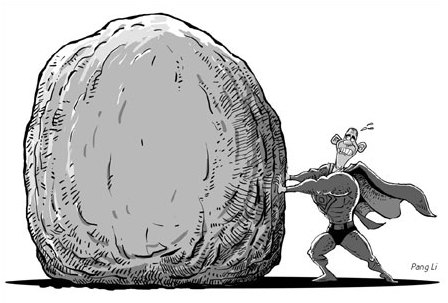 But this anticipation is also a problem for Obama, as it will be difficult - and in some instances impossible - for him to meet expectations. There will be no Palestinian state this spring; nor will there be a global climate change pact or a new trade accord or an end to poverty or genocide or disease anytime soon.
The reasons go beyond the reality that big accomplishments require time and effort. The new president faces extraordinary constraints - constraints that will make it essential for other countries to do more if stability and prosperity are to be the norm rather than the exception.
The most obvious limitation stems from the state of the US economy. Two million jobs disappeared in the last four months alone. The housing market continues to deteriorate. The Untied States' GDP is contracting at an almost unprecedented rate.
As a result, Obama will have no choice but to devote the lion's share of his time and attention to reviving the economy. More than anything else, his success in this domain will determine the perception of his administration. Even he acknowledges that this will require him to delay fulfilling several other campaign promises.
FULL ARTICLE
OP-ED: Blaming China is Bizarre (China Daily, CHINA)
The ongoing global financial crisis, triggered by the bursting of the property bubble in the United States, has severely hit the world economy over the past year. No country, including fast-growing China, has been immune to the financial woes.
Global efforts are being mobilized to tackle the unprecedented financial tsunami. But former US treasury secretary Henry Paulson recently blamed China and other countries for causing an imbalance in the global economy and pushing the crisis with their high bank deposits. Federal Reserve Chairman Ben Bernanke even claimed that such a high savings rate in foreign countries, in China in particular, had induced the bubble in the US real estate industry to bulge.
Such groundless criticisms from high-ranking US officials are extremely detrimental to the current worldwide battle against the crisis. They not only run counter to the simple economic principles, but have also confounded the relations between the victim and wrongdoer. These remarks also exhibit the obvious intention of the top US financial authorities to shirk their responsibilities for poor financial performances and shift domestic dissatisfactions to other countries.
FULL ARTICLE
06 December 2008
Somalia May Haunt U.S. Again (China Post, CHINA)
Barack Obama’s incoming administration could be stuck on the horn of a security dilemma in the strategic but unstable horn of Africa.
A widening Somali crisis which has challenged both George Bush I and the Clinton Administrations, with disastrous consequences, now confronts Obama with the specter of “Blackhawk down” in Mogadishu. The combination of a failed state, a widening humanitarian disaster, and the growth of offshore piracy against international shipping, creates a dangerous vortex in East Africa astride strategic shipping lanes of communication.
It also throws down the gauntlet to the incoming administration and NATO to ensure maritime security in the troubled waters off East Africa.
FULL ARTICLE
26 November 2008
OP-ED: Obama Likely to Opt for Strategic Retraction (China Daily, CHINA)
When Barack Obama is officially sworn in as the 44th president of the United States, the world he faces will be very different from the one his predecessor George W. Bush did eight years ago. The days when the US sat comfortably relishing the spoils of the Cold War are long gone, as the war in Iraq and the spreading financial crisis have dragged the country into a difficult situation it has not seen for decades.
What does all this mean to the Obama administration when it takes office or to the US for that matter? Taking a cue from a slew of signs, I believe that Obama's government will very likely pursue a strategic retraction, meaning the US will very likely enter a period of strategic adjustment.
The last time the US underwent a strategic retraction was in the early 1970s. The starting signals came in then President Richard Nixon's address to the nation on the war in Vietnam on Nov 3, 1969 and the annual foreign affairs report his administration submitted to Congress in Feb 1970.
FULL ARTICLE
Subscribe to:
Posts (Atom)

 Posts



